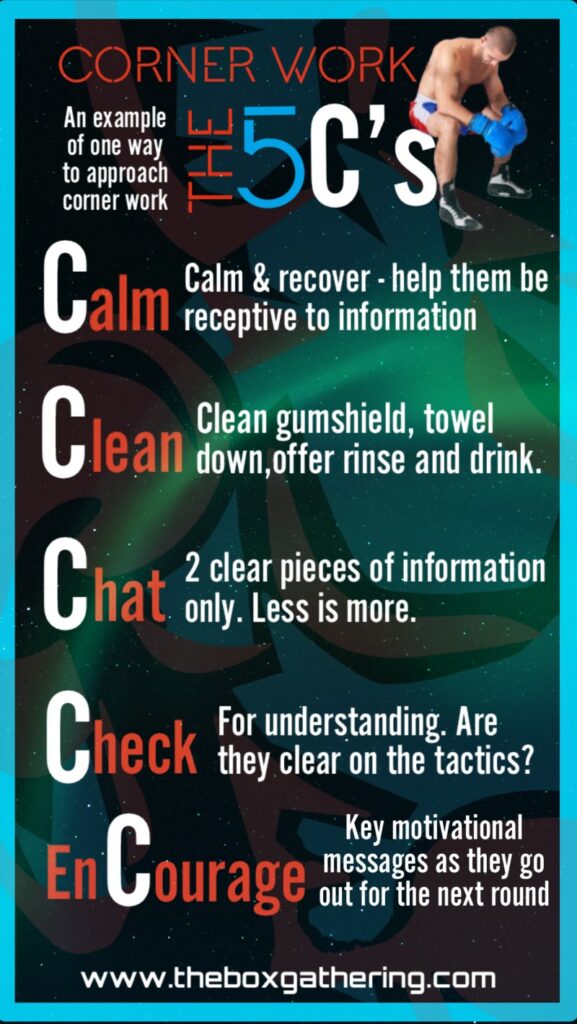

In this episode, we cover an essential aspect of boxing that often doesn’t get enough spotlight: the craft of effective cornering. We break down our own framework for cornering: the Five C’s of Corner Work.
These are Calm, Clean, Chat, Check, and enCourage—a simple yet powerful checklist designed to give you a practical method for supporting your boxer in the corner.
Why Effective Corner Work Matters
Before diving into the five C’s, let’s think about the chaos and vulnerability that come with those between-round moments. The boxer is tired, infact they’re absolutely knackered, they’re fatigued and they are less receptive at that immediate point they get back to the corner.
Our priority as coaches is to get them ready for the next round, but too often we rush into preparing for the next round ahead of supporting our boxer’s recovery from the previous one. It doesn’t matter what we say to the boxer in that golden minute between rounds if they don’t hear and comprehend what we say.
Calm: Setting the Tone
The first C is Calm.
Before anything else, the boxer needs to recover. We need to support that recovery and help calm them and ensure they breathe. But calm refers every bit as much to the coach as the boxer. When we climb up through the ropes, we want to do it quickly, but we need to do it calmly.
If you storm into the corner flustered, the boxer will pick up on it. Your body language and voice matter. Slow down, make eye contact, and keep your voice steady. A calm demeanor sets the tone for recovery and focus. And we need our boxers focused so that we can provide the information they need for the next round.
Of course, you have to know your boxer. Some boxers need intensity kept high, others need it brought down. Building these relationships in training, and particularly in sparring, as well as discussing with your boxer what they feel they need, will allow you to tailor the level correctly.
Clean: Comfort and Clarity
The second C is Clean.
We’re wiping the face, we’re clearing the eyes with the towel. Nobody wants sweat in their eyes. The boxer is still recovering while we’re doing this, while we’re focusing on cleaning their face, offering water sensibly (don’t force water on someone still gasping for breath!), and going through the small comforts like an ice pack on the back of the neck that help the boxer reset and focus.
As a side note on towels, consider the colour of the towel. A white towel shows blood, and if you’re wiping blood all over the place, it can stress the boxer, or it might not look good for the referee. Pick a dark colour and make sure that each boxer has their own clean towel.
Chat: Clear, Simple Communication
Here’s where coaching can make the biggest impact. The third C is Chat.
The chat depends on what your analysis is during the round. What can you say that will have the most important thing to have an impact in that golden minute?
Often we concentrate on what our boxer needs to do, but we should also keep in mind what the opponent may be gearing up to do. So maybe during the round, one coach looks at their boxer and the other coach looks at the opponent, before deciding which one or two points should be delivered to the boxer.
And really, one or two points is about as much as most boxers will take in, cover three if you must, but it depends on the boxer as well. Less is more, and by using simple, memorable cues and anchor words such as “jab, control the gap,” a lot of information can be delivered in just a few moments. If you’ve practiced these words and phrases in the gym and through the lead-up preparations for the bout, it’s far more likely that the instructions you provide will stick under pressure.
Check: Confirm Understanding
The fourth C is about making sure your message has landed: Check.
After delivering information, we need to check for understanding. So we’ve given two points, maybe three points, and then we ask back, What are we going to do? What was the first thing we’re gonna do? If the boxer can’t articulate quickly what they need to do, it’s unlikely that they’ve actually understood what those instructions were. Some boxers might need more specific prompts, like “what are you going to do with the front hand?” and again, what question to ask comes down to knowing your boxer.
Remember, the boxer is fatigued and in a stressful environment. Don’t assume your message was received. Using a quick check, “What’s the first thing we do?” to test understanding ensures that if the boxer doesn’t understand, you still have a chance to convey the information in another way before the next round starts.
enCourage: Finishing Strong
Last, and definitely not least, is enCourage.
Up until this point, only one coach should have been talking. But here’s where other coaches can now jump in if they want to. That might look like the second giving a little slap on the heel as the boxer goes away, with a “Come on. You can do this.”
A few seconds of encouragement can provide that final boost of motivation that makes a difference to the boxer. What those words and motivation should be depends very much on your boxer. Know when your boxer needs fire, and when they need reassurance. We’ve all seen coaches taking a drill-sergeant approach with a boxer, because that’s how they coach, when what the boxer needs in that moment is something to boost their confidence.
Practical Advice: Practice and Feedback
As coaches, we focus so much on getting our boxers ready for a bout, we often neglect getting ready for our role. And in order to get ready for our role, we need to prepare with the boxers we are supporting. Many coaches only perform corner work, and there’s a big difference between the performance of what you’re doing and practicing it.
Take the time to practice this in sparring, set sparring up in a way that coaches get to practice cornering, and have the time to discuss and reflect with the boxers and other coaches about what worked and what didn’t with that practice.
Final Thoughts
What happens in the corner can make or break a bout, so it’s up to us as coaches to make sure that the one part of the bout we control goes as smoothly as possible. By using the Five C’s, Calm, Clean, Chat, Check, Encourage, we can structure our approach to help boxers get what they need in the moment and make sure advice is actually understood and applied.
For boxers reading this, understanding this process can help you advocate for yourself. It’s up to you to let your coach know what you need, and reflect after fights about what worked for you in those crucial minutes.