

Understanding the Impact of Parental Involvement and Building Strong Relationships for Better Boxing Outcomes
In Episode #17 of the Boxing Coaches Podcast, we explain how parents can support or hinder their child’s progress and why coaches should consider this influence. This episode offers useful insights for coaches and parents about working together to support young boxers.
Why the conversations outside the gym matter just as much as the training inside it
Boxing coaches spend countless hours helping boxers develop technically, physically, and mentally. But for young boxers especially, much of what shapes their experience of the sport happens outside the gym, with their parents.
Coaches might only influence a young boxer for 1% of their week. Parents shape the other 99%.
Some parents support their child’s journey by encouraging and believing in them. Others, even unintentionally, can add pressure or cause confusion. Parent involvement can be helpful or challenging, depending on how it’s managed.
Coaches cannot completely separate parents from the process, even if they sometimes want to. Young boxers usually do best when the messages they hear at home and in the gym are consistent.
The Car Journey: How Language Shapes Boxing Experiences
The car ride home is a key moment. It’s often where young boxers process and remember their experience. What parents say on the way home can shape how a young boxer feels about their performance long after the bout has ended.
Some conversations sound supportive on the surface, like “Great win. Onwards and upwards to the next one and we’ll smash him too”, while others are more openly critical: “You obviously didn’t listen to your coach… I was shouting to throw your jab more.” Although one response sounds harsher than the other, both conversations focus heavily on the outcome rather than the learning behind the performance.
“The car ride home is still part of the competition experience.”
The moments after a bout can feel overwhelming for young boxers. Even confident boxers may feel frustrated, embarrassed, emotional, or mentally exhausted after stepping out of the ring. In those moments, emotional support is often more valuable than immediate technical analysis.
Most parents speak from a place of pride, care, and emotional investment. However, even well-intentioned reactions can unintentionally increase pressure and shape how young boxers experience competition.
Process Over Outcome
Young boxers quickly absorb the language, reactions, and emotional cues of the adults around them. In boxing especially, where performance is highly visible and emotionally charged, this environment becomes a major driver of boxer development.
What adults say and do after a match affects how young boxers see themselves. If every conversation focuses only on winning or losing, kids may think their worth depends just on the result. A boxer may forget the scorecard, but they rarely forget how adults made them feel immediately after competition.
This is where process-focused praise becomes essential. Instead of immediately asking:
- “Did you win?”
- “Why didn’t you throw more punches?”
- “What was the referee doing?”
- “Why didn’t you listen to your corner?”
Parents can ask:
- “Did you enjoy it?”
- “What did you learn?”
- “What are you proud of?”
- “What felt difficult?”
- “How would you like to improve?”
These conversations encourage reflection rather than defensiveness. This kind of feedback reinforces learning and helps young boxers separate performance from personal value.
From a growth mindset perspective, When young boxers see mistakes as chances to learn, they become more resilient and keep trying. Encourage children to see challenges as opportunities to grow, not as proof they can’t improve. This supports resilience, persistence, and long-term engagement in the sport.
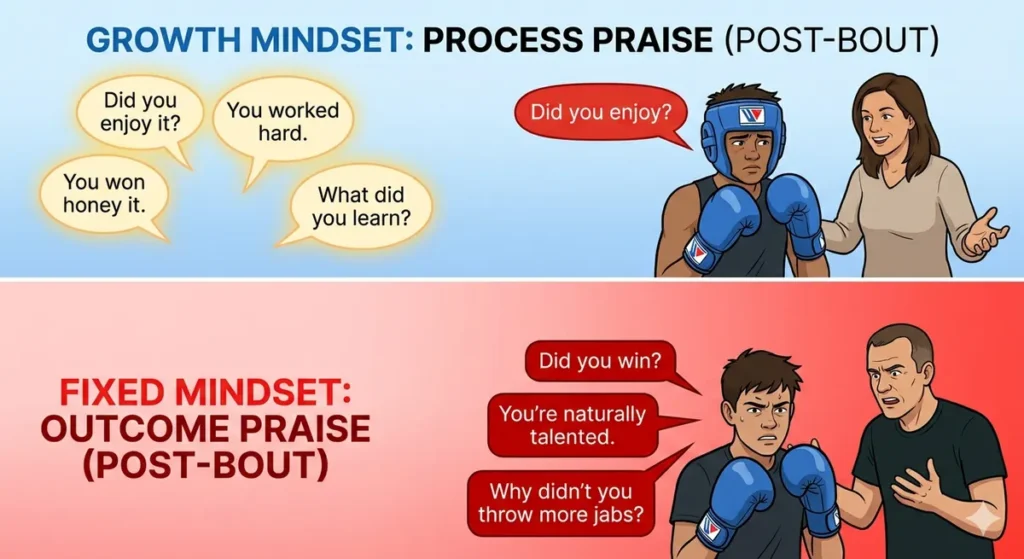
“Those with a growth mindset will embrace challenges, see adversity as an opportunity to learn and grow.”
Adult language plays a decisive role here. Praise that emphasises effort, discipline, composure, and decision-making strengthens intrinsic motivation and reinforces boxer-centred development. In contrast, praise based solely on winning or talent can unintentionally create fear of failure and dependency on external validation.
“Win or lose you must be proud of how hard you worked.”
Process-based praise sounds like:
- “You handled pressure well.”
- “You showed bravery.”
- “You worked hard.”
- “You improved from last time.”
Outcome-only praise sounds like:
- “You’re naturally talented.”
- “You’re unbeatable.”
- “You’re better than everyone else.”
Over time, those differences shape how boxers view challenge, pressure, and setbacks.
In practical terms, this means:
- Praise hard work, not results: “You worked really hard on that,” rather than “You’re a star.”
- Encourage learning from mistakes: Help parents see and discuss the positives even in losses or setbacks.
- Reframe the home conversation: Avoid pure “Did you win?” chat; instead, ask about enjoyment, effort, and new skills learned.
Coaches Must Model the Behaviour They Want to See
Young boxers learn a lot by watching how coaches and adults behave, especially after tough moments. They notice how coaches react after losses, how adults speak to officials, how disagreements are handled, and whether people remain respectful under pressure.
“Young people need models, not critics.
Coaches, Parents, and Clear Roles
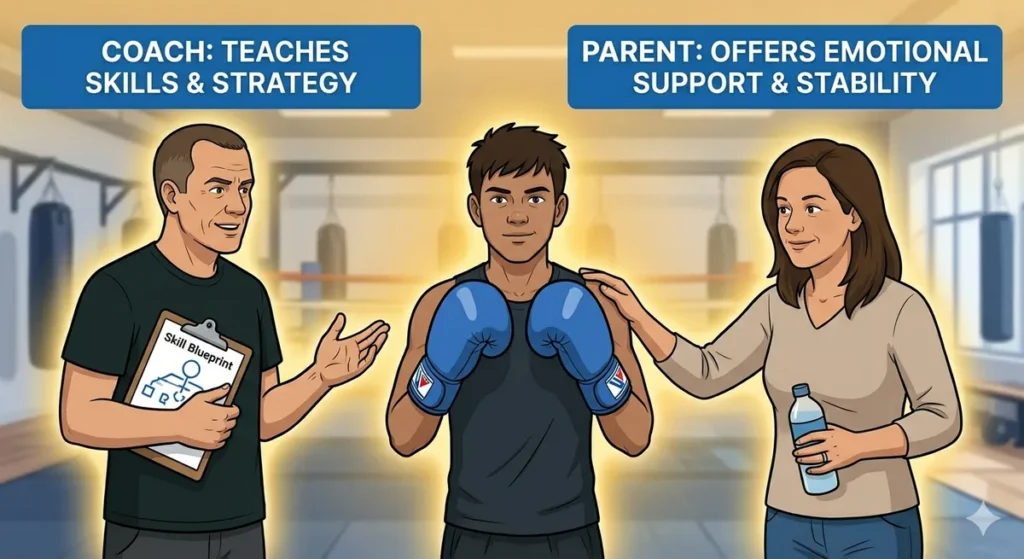
Clear role boundaries are essential in youth sport. This distinction is critical in youth sport. When parents begin offering technical instructions, tactical opinions, or emotional reactions that conflict with the coach’s guidance, young boxers can become confused and overwhelmed. Young boxers should never feel caught between two coaches.
|
Coach’s role: |
Parent’s role: |
|---|---|
|
Teach skills, guide development, make performance decisions. |
Offer emotional support, provide stability, encourage positive values. |
The most effective sporting environments are usually the ones where these roles are clear and respected. That does not mean parents should be excluded from the journey. In fact, we would argue strongly against that idea. Instead, coaches should work to involve parents appropriately while maintaining firm boundaries around behaviour and responsibilities.
Building Positive Club Culture Through Parent Engagement
Strong club culture does not happen accidentally. It must be built intentionally through communication, consistency, and leadership.
Many coaches have experienced frustration with difficult parental behaviour. It can be tempting to completely separate parents from the coaching process altogether. However, long-term success often comes from education rather than exclusion. There are several practical ways clubs can improve relationships with parents while keeping boxers at the centre of everything:
- WhatsApp Groups: An effective tool for day-to-day updates, event info, and, importantly, communicating club values and expectations.
- Parental Meetings: Organize informal meetings where coaches can explain aims and approaches, answer questions, and foster open, two-way communication.
- Ground Rules for Engagement: Every meeting needs agreed-upon basics, listen without interrupting, use positive language, focus on supporting boxers, so discussions remain constructive, not confrontational.
Parental insights can also be valuable; sometimes parents spot things coaches miss. When coaches and parents work as allies, everyone benefits.
The goal is alignment, not control.
Key Takeaways for Coaches:
- Open Communication is Essential: Use meetings, messaging apps, and transparent processes to keep parents in the loop.
- Define Roles Clearly: The coach coaches. The parent supports. Make this explicit early and revisit as needed.
- Encourage the Right Language: Share practical examples with parents on how to talk about boxing with their child, especially after competitions.
- Model Desired Behaviours: Both coaches and parents should practice the attitudes and language they hope to see in their young boxers.
- Empower Parents as Allies: Involve them, listen to their insights, and treat them as partners on the journey.
- Stay Firm on Non-Negotiables: Some behaviours and boundaries are non-negotiable, for everyone’s benefit.
In Closing: The Power of Collaboration
Developing resilient, confident young boxers is a shared responsibility. Coaches provide structure, guidance, and expertise, while parents shape much of the emotional environment surrounding the sport. When those influences work together rather than against each other, young boxers are far more likely to thrive.
The strongest boxing cultures are not built solely on winning. They are built on trust, communication, consistency, and relationships that support long-term development both inside and outside the ring.
For coaches, that means communicating clearly, setting healthy boundaries, and helping parents understand how best to support their child. For parents, it means recognising that emotional support often matters more than technical advice. And for young boxers, it creates something invaluable: an environment where they can compete, struggle, learn, and grow with confidence.
For more insights, open discussions, and resources on coaching and boxing development, become a member to join the conversation at The Box Gathering community.