

Most boxing coaches use sparring every week. But are we using it to simply test our boxers, or are we helping them become better at adapting to different situations?
In this episode, we explore Shark Tank Sparring, a training method that exposes a boxer to multiple opponents within the same round. It might look like a tough conditioning drill, but there’s much more to it than that. Used well, it helps boxers make better decisions, adapt to different opponents and stay composed under pressure.
What Is Shark Tank Sparring?
In its simplest form, one boxer remains in the ring while several fresh sparring partners rotate in throughout the round.
For example, during a three-minute round, three different boxers may each spar for one minute before the next partner enters. In a two-minute round, each partner may work for forty seconds. The boxer stays in the ring while fresh opponents keep rotating in. Every time someone new steps through the ropes, they bring a different style, a different pace and a new problem to solve.
Instead of adapting once at the beginning of a round, the boxer must adapt several times. That constant need to adapt is what makes the exercise so useful.
Imagine your boxer starts against an aggressive pressure fighter who likes to crowd the space. After one minute, that boxer leaves and is replaced by a tall outside boxer who controls distance with a long jab. Another minute later, a southpaw steps in and completely changes the angles. Within a single round, your boxer has already experienced three very different tactical challenges.
Shark Tank Sparring isn’t about surviving fresh opponents. It’s about learning how to recognise new problems and adapt quickly.
Why Adaptability Matters

One of the hardest parts of amateur boxing is that you rarely know exactly what kind of opponent you’ll be facing.
Most of the time, boxers know very little about the person standing across from them. They may not know whether they’re facing an orthodox or southpaw boxer, whether the opponent likes to pressure or counter, or whether they’ll fight at a fast or slow tempo.
Competition rarely gives you time to settle in. Instead, successful boxers recognise information quickly and adjust.
Shark Tank Sparring brings that uncertainty into training, giving the boxer a chance to practise adapting before competition. One opponent might pressure forward. The next might stay on the back foot. Another might constantly change rhythm. Every new partner asks the boxer different questions. The boxer has to recognise those changes and respond accordingly instead of relying on one familiar game plan.
The more often a boxer has to solve new problems in training, the more comfortable they’ll become when things don’t go to plan on fight night.
Learning Through Interleaving
One of the key ideas we discussed in this episode is interleaving.
It sounds complicated, but the idea is actually quite simple. Instead of practising the same situation over and over again, the boxer is constantly faced with slightly different problems.
Think about a normal sparring session. A boxer might spend several rounds with the same opponent, gradually getting used to their style. In a Shark Tank, that doesn’t happen. Just as they begin to figure one opponent out, someone new steps in with a completely different style. That constant change forces the boxer to think, adapt and make new decisions throughout the round.
A coach might normally have a boxer spar the same tall southpaw for several rounds. That can be useful when preparing for a specific opponent. Shark Tank Sparring takes a different approach. Every fresh opponent asks different questions, so the boxer has to keep finding new answers.
It usually feels harder, and that’s exactly the point. Instead of relying on one solution, the boxer starts learning how to adapt to whatever is in front of them.
Imagine a boxer who struggles when the pace suddenly changes. Rather than using one fast sparring partner all session, the coach rotates three different boxers. One works at a steady pace, another attacks in short bursts, while the third constantly changes rhythm. Instead of learning one opponent’s habits, the boxer learns how to recognise changes in tempo.
“Better learning doesn’t always look like better performance straight away. Sometimes slower progress today creates smarter boxers tomorrow.”
Repetition Without Repetition
The goal never changes. Every boxer is still trying to land clean shots while avoiding getting hit. What changes is the way they have to solve that problem.
A taller boxer creates one challenge. A southpaw creates another. A pressure boxer takes away time, while a counter boxer makes every attack feel like a risk.
Although the objective stays the same, the answers are always different.
That’s where Shark Tank Sparring becomes so valuable. Instead of practising one solution until it becomes ‘automatic’, the boxer builds a wider range of skills that can be used against different styles and different situations.
Over time, that creates a more adaptable boxer who is better prepared for the unpredictability of competition.
Variability Creates Better Decision Makers
Every opponent gives the boxer different information. It could be the distance they fight at, the speed they work, their timing, footwork or the way they defend. Some boxers pressure forward. Others stay on the back foot and wait for mistakes.
The challenge is recognising those differences as quickly as possible.
Instead of trying to use the same tactics against everyone, the boxer learns to adjust to what’s happening in front of them. That’s much closer to what they’ll experience in competition.
Imagine a boxer who likes to come forward. The first opponent allows them to apply pressure without much resistance. The next circles away and makes them work to close the distance. The third looks to counter every attack.
Why Learning Can Feel Slower
One thing coaches should expect is that Shark Tank Sparring doesn’t always produce instant results. At first, the boxer may make more mistakes. They might struggle to find the right tactics or look less confident than they do during more familiar sparring.
That doesn’t necessarily mean the session isn’t working. Every fresh opponent creates a new problem, so the boxer spends more time thinking, adjusting and experimenting. Learning often looks messy before it looks polished.
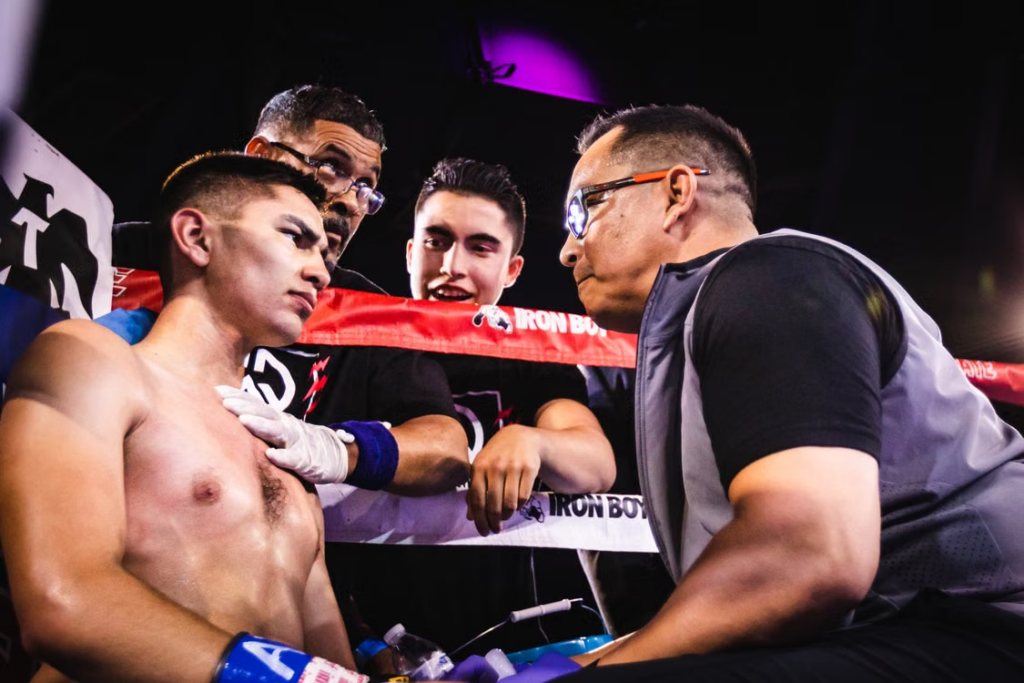
Shark Tank Sparring is different. It challenges the boxer to solve new problems over and over again, which takes longer but often leads to deeper learning that transfers better into competition.
What Coaches Can Take From This
Shark Tank Sparring is not simply about making a session harder. Its real value comes from giving boxers the opportunity to adapt to different opponents and solve new problems under pressure.
Like any training method, it needs a clear purpose. Rotating fresh sparring partners without a coaching objective can quickly become nothing more than a physically demanding drill. However, when coaches carefully choose the styles, pace and challenges each opponent brings, Shark Tank Sparring becomes a powerful way to develop decision-making, adaptability and tactical awareness.
It is also important to remember that learning does not always look impressive. A boxer may make more mistakes or look less comfortable at first because they are constantly adjusting to new situations. That struggle is often part of the learning process.
If this episode has made you think differently about how you use sparring, ask yourself one simple question before the next session: Are you testing your boxers, or are you helping them learn?
Practical Takeaways
Here are some tips for using Shark Tank Sparring in your own gym:
- Use Shark Tank Sparring to develop adaptability, not just toughness.
- Rotate opponents with different styles to create new problems for the boxer to solve.
- Request that boxers box in a certain style to ensure there is varied challenge.
- Encourage the boxer to recognise changes in distance, timing and tempo instead of relying on one game plan.
- Remember that making more mistakes during practice does not always mean learning is getting worse.
- Use a variety of opponents to build better decision-making rather than repeating the same situation.
- Plan each Shark Tank session with a clear coaching objective instead of simply making it physically demanding.
- Give the boxer time to reflect after each round so they understand what they learned from each opponent.