
In this episode, we talk about the similarities between the mental tools used by boxers and ultramarathon runners and what it’s like to run the length of an entire country.
I was never interested in running when I was a boxer, I ran because I was told to get my runs in if I wanted to box. It was a sport I was late getting to. I had started kickboxing at 26, and boxing a year later. A series of knee injuries stopped me from seeing how far I could go. Instead I took what I had learnt about coaching from Ivan Cobb and took that across knowledge back to kickboxing. After coaching the Cambridge University Kickboxing Society, I moved back to coaching boxing, bringing some of what I have learnt across in the other direction. Along the way I ended up getting involved with The Box Gathering, where I help to keep the site operational.
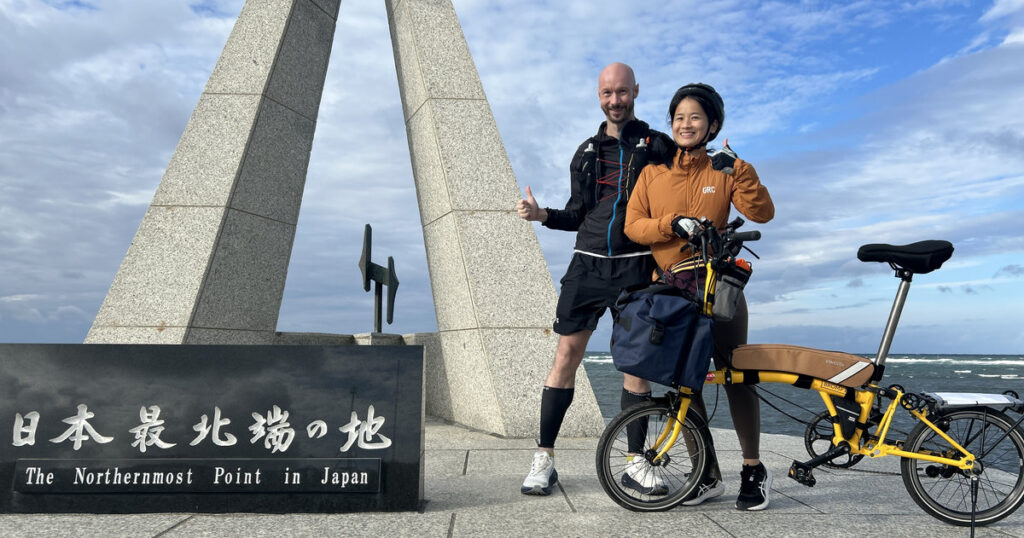
Last autumn, I ran the length of Japan. 3,447 kilometres (2141 miles), in 80 days. That’s just over a marathon a day. My partner Joy cycling alongside me on a Brompton folding bicycle carrying all our gear. It was not some epic journey of endurance, it was just a silly idea that got out of hand. And here’s what I’ve taken from it, and fed back into my own coaching.
Mentality Matters
Boxers tell me they could never run that far. Runners tell me they could never get punched in the face. Both are wrong. They already have the thing they think they’re missing. They’ve just never tested it in the other context.
Boxing and ultra running share a mythology. Suffer more, get tougher. Grind through the pain. Build character by breaking yourself down. It sounds compelling. It looks good on Instagram. And I think it’s mostly wrong. I’ve stopped believing in mental toughness, or at least, the version we usually sell.
And not because pain doesn’t happen. It does. I’ve spent a lot of time as an athlete deep in the pain-cave. I’m not sure pain is optional when you do difficult things for a long time. But you don’t have to turn it into a suffer-fest, you don’t have to be a tough guy to battle it out. I don’t consider myself a particularly tough guy. I didn’t run over 2000 miles by being tough. I did it by doing the next thing. Simple as that.
Motivational speeches seem like the flip side of the same coin to me. Go on YouTube and there’s all the motivational talks with epic music “be the lion,” “it’s yours to take,” “how bad do you want it” but motivation ebbs and flows, you can use it when it comes, but not rely on it. Nobody stays motivated every minute of the boxing season.
Finishing running the length of Japan, I wasn’t digging deep, I wasn’t always motivated, I was just getting on with it.
Emotions Are Information, Not Instructions
There was one time when I felt proper rubbish. I just sat there and let myself feel a bit rubbish for ten minutes and then we carried on. I didn’t give myself a speech. I didn’t push through. I sat with the feeling, then I kept going.
I think this skill matters in the gym too. How often are boxers coming to us saying something hurts or they are not feeling it today? I think we often jump to motivation as the solution here, either through encouragement or tough love. We rarely teach acceptance as boxing coaches. Okay, today isn’t great, nothing is working, that’s fine, it happens. What are you going to do about it? Solve the problem
If you let your emotions dictate your performance in training, what about the day of the bout? You can’t go “oh, I’m not feeling it today” thirty minutes before you step in the ring. Just get on with the work.
It’s something I learnt through Zen Buddhism. We don’t have to treat every emotion as an instruction to act. My knee hurts. That’s a fact. “My knee hurts” and “I should stop” are two different statements. It’s possible to hold the first one without it automatically becoming the second.
This is different from “push through the pain,” because there’s no fighting anything. It’s not denying the feeling or overriding it with willpower. You’re just noticing it and noticing that it doesn’t require you to stop.
When you’re 20 kilometres from home on a training run, nobody is coming to help you. Sitting by the side of the road doesn’t get you any closer to home. When you’re in the ring, your corner can shout instructions, but they can’t throw the punches. In both disciplines, I wouldn’t say you’re alone necessarily, but you are the one who has to take action. The question is how you approach those actions. And I’d suggest that what works is not just gritting your teeth. It’s working out how to solve the problem in front of you.
The Brompton Problem
Before travelling the length of Japan, my partner Joy had one night’s camping experience. Her longest cycle was 30 kilometres. She has none of the “built tough” backstory. No grind mentality. She just came out to Japan and cycled the entire length of the country on a folding bicycle.
One evening, she crashed her bike into a ditch after an animal startled us in the dark. She was pretty banged up, I’m still amazed there wasn’t a serious injury as we were coming down a mountain pass. We got to the bottom of the hill, and at a vending machine she said she wanted to quit. Not dramatically, just as a fact, the way you’d say you wanted to sit down. I got her a hot tea. There isn’t much useful to say when someone who’s been cycling a loaded Brompton through Japanese mountains for forty-seven days tells you they want to stop. You can’t tell them it’ll get better, because you don’t know that. So I handed her tea and told her what an achievement it had been that she’d made it this far.
My job there was the 5 C’s of Corner Work: Calm, Clean, Chat, Check, enCourage. Make sure she was okay and help her get safely to the campsite. She couldn’t just sit there next to the vending machine all night. We picked ourselves up and we went again, off into the dark and to our campsite. In the morning she got on the bike and we set off.
That’s not mental toughness. That’s just doing the next thing. And if someone with no endurance background can do that, then maybe mental toughness isn’t something we need to build. Maybe it’s something people already have, our job as coaches is less about throwing them into it, and more about giving them the problems that help them discover it, at the right challenge point for them.
I think one question we need to ask ourselves as coaches is how often are we pushing away potentially great boxers because they initially lack what we perceive as the right mentality, rather than us letting that mentality emerge.
What This Means in the Gym
Perhaps we default to building toughness because it’s so tempting to believe that’s the bit that matters. I’m no longer convinced we need to build it. Toughness is what happens naturally when we put someone in a situation where the difficulty is interesting rather than just punishing, and they discover they can handle it. Our job is creating the environment, not the suffering.
There’s a massive difference between someone thinking “I’ve got to get through this” and someone thinking “I wonder if I can figure this out.” I think the second person learns more about themselves.
I have a boxer who’s recovering from a shoulder injury. He was at a gym where they did too many rounds of hard sparring, because that’s what builds toughness. Boxers love sparring, how is that helping them get tougher? He hates running, so guess what he gets to do more of? That’s his challenge. Can he take himself out and do an easy run once a week, be consistent with it, and manage his boredom? I’m curious as to whether he can solve the problem and find a way to enjoy it.
Eighty Days of Conditioned Sparring
Running across Japan was a constraints-led approach to everything. Every day the task changed: different route, different weather, different pain. The constraint was never the same twice, but the problem had a familiar shape: get from here to there with what you’ve got. Repetition without repetition.
I’ve done enough solo-hiking and ultramarathons to know how to operate myself. This time I had a new constraint: I had to consider my partner’s needs as well. Over time we faced so many variations of the same problems that the solutions became obvious. Another day, another problem, another solution. You can’t drill running the length of a country, you can’t drill what happens in a bout.
Each night, I’d sit in the tent and draw the following day’s route. If we had a support team we’d have potentially been picked up and dropped off at set points each day, but we didn’t. We stopped where we stopped, and had to map out the next session based on the day’s results.
You can’t have a rigid plan in boxing either. A boxer who has sparred ten southpaws shouldn’t need to follow a rigid plan against the eleventh, they’ve developed an understanding of the problems a southpaw presents, they know roughly what works. They have their tools and solutions for this problem, and if this southpaw does something they’ve never seen before, then they’ll figure this problem out.
It’s where I’m a big advocate for CLA, I think allowing the boxer to solve their own problem may make initial progress slow, but it accelerates learning later on. Some boxers, in that first round, encounter a fresh problem, and they find a solution. Others are reliant on their coach telling them what to change at the end of the first round. And by that time they may be a round down. Boxers should be taught to solve their own problems. Teach the boxer how to fish, rather than giving them the fish.
I think one area where I perhaps part company with CLA thinking here is the specificity. There’s a strong argument for specificity: make the training environment as close to competition as possible. Boxers shouldn’t need to go on long steady-state runs because they don’t box in a steady state. Make the problem space match being in the ring. And for skill acquisition, that’s probably right. But CLA in boxing shouldn’t become myopic about boxing skill acquisition.
I don’t want my boxers to just be able to solve problems in the ring. I want my boxers to be able to solve all the problems that come at them. I think every coach can think of a boxer who could have gone really far, but has dropped out of sport for reasons that have nothing to do with their skill level or their love of boxing. It doesn’t matter if you’ve got the perfect method for developing boxing skills if the boxer isn’t there anymore. Boxing does not exist in isolation and we should be helping our boxers solve more problems than just the ones in the ring.
Focusing on fitness and boxing skills is a necessary part of coaching, but first and foremost, I want my boxers to turn up to the gym consistently. I think consistency is the most underrated skill in boxing. After that, coaching is easy. The ring problems take care of themselves if the person is still showing up.
There is no Finish Line
And showing up is exactly how you run the length of the country. No big secrets, no epic feats of endurance. Just show up each day. It’s not glorious, it doesn’t make for a successful Instagram account, but in pretty much any walk of life, just showing up gets you where you want to go.
There was no medal, no crowd, no big sense of occasion when I hit the end of the road. It was just doing the same things we’d done for almost every day for the previous 79. In fact, I had to turn around and run 6 km back to the nearest campsite.
Most training sessions end the same way; you pack your bag and go home. The ability to do that, five hundred times, without needing the drama, is the actual skill. Not pushing through. Not grinding. Just showing up, doing the work with some curiosity about how it goes, and coming back tomorrow.
You can watch the YouTube series of me running the length of Japan at https://www.youtube.com/@ultramarathonlife