

Over the years we have had some fantastic conversations with some of the best coaches and coach educators across the globe. We are so lucky to have gleaned insights, advice and experience from each and every one of these people.
This is a one stop page for coaches, boxers and indeed anyone interested in the constraints led approach. You will find some of our podcast episodes, multiple articles and examples of the work these people bring to their striking sports.
We are sure you’ll find it of great value!
What is a Constraints Led Approach (CLA)?
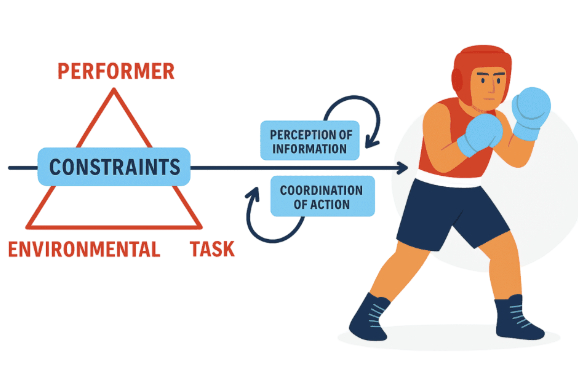
A constraints‑led approach in boxing is a powerful way to develop adaptable, intelligent boxers. Boxing traditionally adopts what’s known as a ‘linear approach’ to coaching where a technique is introduced, often demonstrated, the boxers then practice it on a bag, pads or using shadow boxing then move on to more complex aspects assuming that that technique is now ‘acquired’ and ready to be used in competition. Rather than drilling fixed techniques in isolation and hoping that these techniques transfer into competition, the CLA shapes skill through task, environmental, and individual constraints that mirror the realities of competition and allow a boxer to attend to smaller yet relevant problems that the sport of boxing poses.
So what is a constraint? When 2 boxers are competing against each other, there is a lot of complexity. Not only is one boxer trying to land scoring blows, but the opponent is trying to land theirs. It is a constant system which ebbs and flows, changing moment to moment. A constraint is a boundary which helps a boxer to attend to relevant information which they notice to help them find multiple ways of solving a task or problem. This could be something as simple as reducing the target areas or punches. How you constrain, shapes the types of solutions which happen or ’emerge’.
For example, if the size of the area in which the spars are significantly reduced, then boxers will have more opportunities to use hand defenses, trunk defenses and lateral foot defenses as the size of the ring (environment) is smaller. Likewise, if the area is made bigger, it allows (affords) the opportunity to move the feet backwards too. Changing the environment changes behaviours.
By carefully manipulating these constraints—such as ring space, timing pressures, or tasks—coaches encourage boxers to search for effective movement solutions instead of copying prescribed patterns. This nurtures perception–action coupling, helping athletes read cues, anticipate opponents, and make rapid decisions under pressure. The approach also supports creativity and resilience, as boxers learn to adapt their style against different opponents and scenarios. Ultimately, the CLA aligns training with how skill is actually acquired in dynamic combat sports: through exploration, variability, and contextual learning. It empowers boxers to become more autonomous, tactically aware, and capable of transferring skills from training to the unpredictable demands of the ring.

Adam Singer

Adam Singer, Coach at SBG Athens, brother of Rory Singer, and first coach of former UFC champion Forrest Griffin, shares his 25-year journey in coaching BJJ and MMA, explaining how ecological dynamics and the constraints-led approach creates more effective fighters despite less technical instruction.
Singer’s coaching philosophy is rooted in ecological dynamics and the concept of aliveness—training that is unscripted, resistant, and representative of real combat demands. Rather than relying on rigid technique drilling, he encourages athletes to explore solutions, adapt under pressure, and develop decision‑making skills through realistic, game‑based scenarios. His approach blends humour, sharp insight, and a deep understanding of how fighters learn. Singer’s methods aim to create versatile, resilient athletes who can integrate striking, grappling, and transitional skills fluidly in live competition.
In episode 97 of our podcast with Adam, we explore the concept of ‘aliveness’ in training, a method which emphasises uncooperative and unscripted drills to help combat athletes adapt and thrive in real combat situations. This episode offers a unique perspective on how to develop versatile fighters who can effectively integrate boxing into their MMA skill set. We also, however, go on to discuss how the rules, environment, equipment and various other constraints of MMA shape the behaviours of the fighters and so how these variables impact how they fight and the reasons why striking is different in MMA compared to boxing.
“Improving striking doesn’t necessarily mean downloading all of the technical components that a boxing coach believes exists in striking.”
The age old argument that boxers are better strikers than MMA fighters is erroneous, purely because the skill sets have to be different due the constraints within each sport. An example Adam gives is that if an MMA fighter were to step in with a jab the way a boxer may, then they are likely to be swept or low kicked, so striking skill-sets have to change and evolve dependent on the rules of the sport and availability of kicks, and grappling etc. So comparing the 2 is nigh on useless.
Adam also teams up with Scott Sievewright below in their fantastic podcast, ‘Learning to Fight.’
We love this. 2 guys having real chats about skill without the fluff. Just exceptional knowledge, openness and synergy between two mates.
Sometimes, the CLA and the ecological approach can be accused of being too academic and prickly – too complicated for those who are interested to apply in their own gyms. But Adam and Scotty do an excellent job of explaining the science from their experiences on the gym floor.
2 coaches fascinated by learning. If you’re looking for a new podcast to understand the CLA, look no further. Both are handsome, both are charismatic, both offered me money to say it…
Scott Sievewright
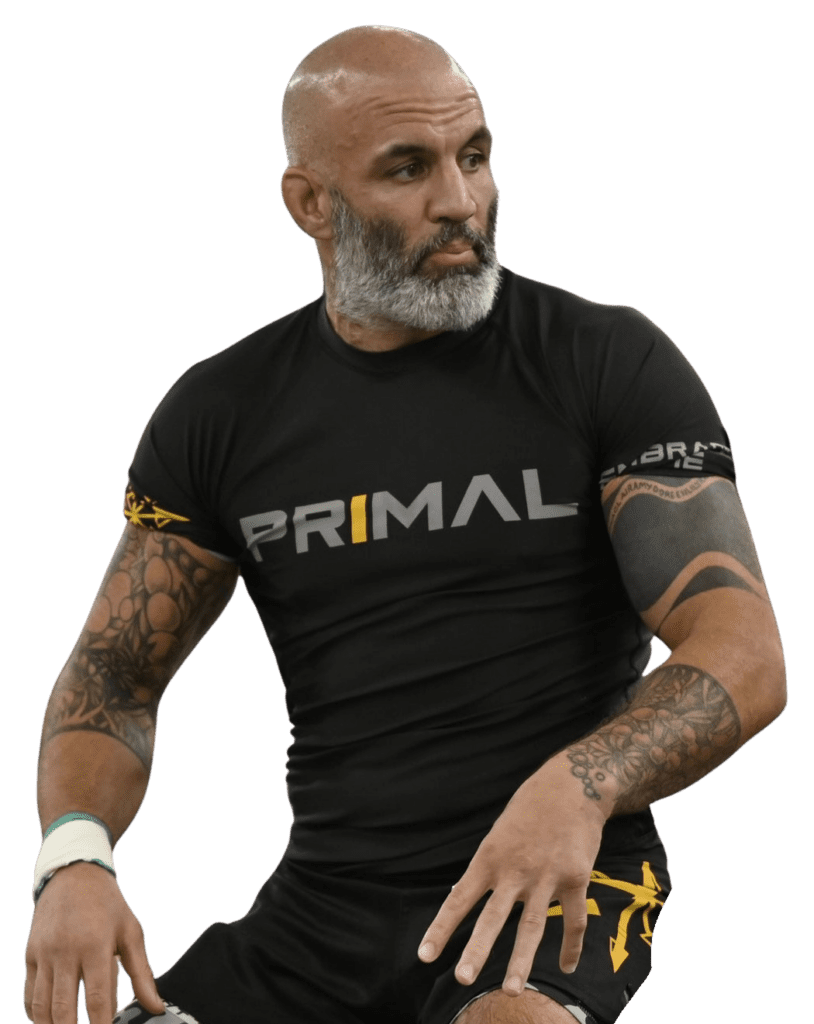
Scott Sievewright is a prominent MMA coach, co-founder and Head Coach of Primal MKE, Milwaukee, Wisconsin and a leading proponent of the ecological approach to martial arts coaching, particularly in striking sports.
He has a background as a competitive martial artist and boxing and has evolved toward focusing on skill acquisition/motor learning through authentic, live training rather than conventional, technique-isolated instruction.
Scotty is also currently undergoing his Masters Degree in Skill Acquisition.
Scotty coaches through the lens of ecological dynamics, placing interaction, adaptability, and perception–action coupling at the heart of his practice. Rather than drilling isolated techniques, he likes to design training environments that invite athletes to explore solutions, adapt under pressure, and develop skills that transfer directly to live combat. Scotty sees fighters as dynamic systems, not machines to be programmed, so his sessions emphasise variability, representative scenarios, and decision‑making in context.
He also advocates for sparring from day one. Scotty believes that movement is information driven and to separate the fighter from the environment doesn’t allow the boxer to self organise towards the task. Sparring from day one in a controlled and safe manner teaches the fighters to tune into their environment right from the get-go.
“Footwork is maintaining a stable and flexible posture to be able to create and absorb force to perform a task. It is functional and information driven.”
From day one, Scotty will also pair his athletes up so they learn to couple and coordinate around the opponent’s movements. These ‘perturbations’ (pushes, pulls, bumps, destabilisations) need to be present in order to self organise. ‘Perfect’ aesthetic footwork is not functional and often folds under pressure when in combat quarters. He is also very cognizant regarding head contact using effective strategies to keep training as representative as possible without causing harm to ‘the old noggin’. This approach builds fighters who can read situations, regulate their actions, and respond intelligently to unpredictable opponents. The result is resilient, adaptable fighters who thrive in the chaos of real competition. As Scotty would say….
‘Embrace the chaos.’

Danny Hatcher
Danny Hatcher is a researcher in the field of Ecological Psychology who creates exceptional content around the application of Ecological psychology, ecological dynamics and the constraints led based approach in sports. Danny is a trampoline head coach who deploys his knowledge daily in his sport.
Danny also has a masters degree in strength and conditioning from the University of Brighton, England.
Below, Danny explains how desirable difficulties can be created to help stretch a boxer just enough to challenge when considering their current level. Have you been in a session and seen that some of your boxers are challenged, motivated, making mistakes, but dipping in and out of success. Or, some are bored, the body language is poor as there is little for them which stimulates or challenges? Then, you also have those who are overwhelmed by the task – little success and frustrated.
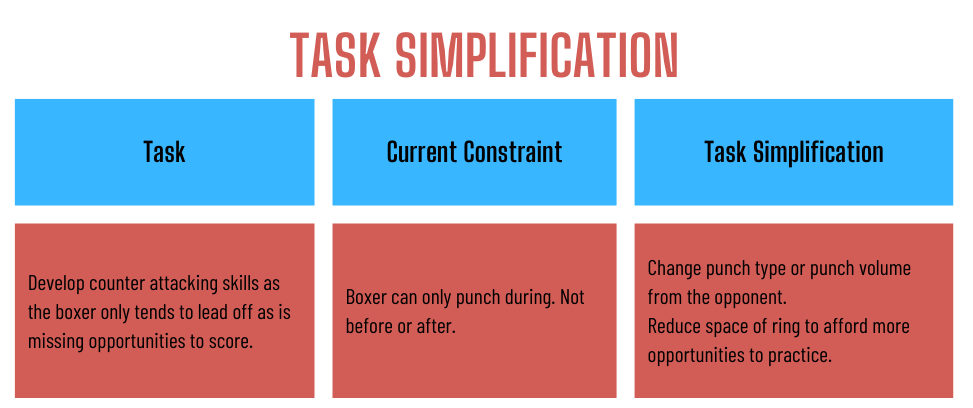
Changing, manipulating constraints and scaling a task can help simplify or challenge the boxer. Simply put, change the environment, change the behaviour.
Constraints and ‘Desirable Difficulties‘
“Change the environment, change the behaviour.”
What task simplification might look like?…
And what might making the task more challenging look like. This is often called, ‘stretch’.
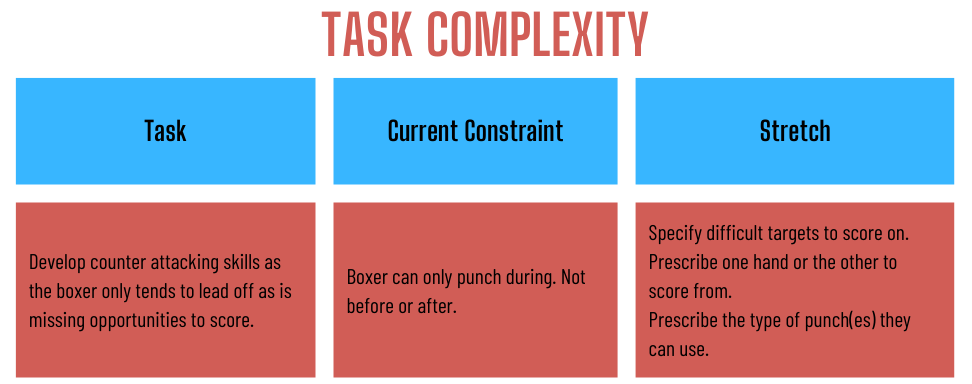
Scaling that stretch and support is arguable one of the hardest tasks of any coach but with a good understanding of task complexity and simplification, AND, having a good relationship with your boxers, you can look to get the challenge point just right.
Again, you can check out Danny and his great work below

Thomas La Cour
MMA coach and BJJ blackbelt
BSc physical education – University of Copenhagen
Ecological dynamics for martial arts
Owner Fundamental Combatives – Efficient combatives training
Co-hosts the podcast ‘Fighting to Learn’, centered on applying ecological dynamics in combat sports and tactical training.
You can DM Thomas for privates, workshops and seminars.
Below we have our podcast with Thomas and Cal Jones about strategies in clinching in boxing
“In a sport of inches, the clinch is where champions steal miles.”
Below, you can read a quick article around clinching in boxing which highlights Thomas La Cour’s framework
“With effective training design and coaching, smaller areas of the fight can be isolated without losing transfer value to a real fight.”
“This guarantees faster learning by way of a much higher amount of dynamic repetitions of the skill being trained, compared to more “open” sparring/exercises.”
“Correct design also greatly lowers risk of concussions and other injuries by making it easier for the coach to control intensity when going live.”
“Combative skills should be developed in a dynamic environment with a resisting training partner as early as possible, bringing the learning environment as close to reality as possible.“
A live training environment is needed to ensure transfer of combatives skills to a real world situation, but it can sometimes be difficult to balance the need for intense “alive” training with the risk of injuries. Thomas offers courses which you can see below.
Fundamental Combatives Courses
Thomas teaches tailor made instructors courses in combatives and defensive tactics, focused on how to run a live training environment while minimizing the risk of injuries.
Subjects covered include:
– How to design training to minimize head injury risk, without loosing transfer value to a real fight
– Using the constraints led approach and “small sided games” to ensure transfer
– Controlling intensity through coaching cues and design of the psychological training environment
– Principles and drills for using padwork to simulate fighting
– Key defensive drills that can be done without hard head contact
– Substituting targets for less head contact in training
It’s great to see such an ethically responsible approach to learning in striking sports using the CLA. We would highly recommend Thomas’ courses and indeed his podcast…
Thomas and Ilhan Akcay’s podcast ‘Fighting to Learn’ explores how people learn to fight—and how fighting reveals how people learn.
Hosted by BJJ blackbelt and MMA coach Thomas la Cour (@thomaslacourtraining) and Fallschirmjäger officer Ilhan Akcay (@ilhan_akshual), the podcast blends experience from combat sports and the military with insights from ecological dynamics and the constraints-led approach.
This is for coaches, fighters, and anyone interested in learning under pressure.
Tobias Horn
Skill Aquisition Coach for Striking | La Familia Fight Club, Erfurt | Attitude Submission Fighting | Master’s Degree in Philosophy
“One of the things that drew me to both combat sports and philosophy is that they are serious pursuits. Neither is silly or funny, and both can, at times, be quite intimidating.
But just because something isn’t funny or silly doesn’t mean it can’t be fun. Fun and seriousness are not mutually exclusive. When we perceive situations as overly threatening, this can lead to heightened arousal, which may negatively affect performance and motor control. Fear is part of competition in martial arts, and overcoming it is certainly a major part of what makes these sports so compelling. However, sending athletes into the ring with a mindset as if they’re entering a “life-or-death” situation will, in most cases, hold them back.
The ability to adapt to new situations and creatively solve problems is likely one of the most important traits of successful athletes. While seriousness and determination certainly provide a strong foundation for this, enjoying the experience can act as a powerful catalyst. Stress, fear, and frustration are the enemies of learning and performance.”
“As coaches, we should help our athletes find their focus and not intimidate them. In the end, it’s “Hit and don’t get hit” and not “kill or be killed”. Combat sports and competition is a serious business, but it should also be fun.“
Practice Design
Tobias is constantly looking at his practice design using the CLA for ways in which he can help develop functional behaviours, particularly around which he says are invariant features of;
- Moving the centre of gravity
- Creating stable structures
- Concentrating force into a small space
Moving the Centre of Gravity
Whether you’re ducking, pivoting, or stepping into a punch, power starts with shifting your weight. Movement of the centre of gravity—through rotation or linear motion is essential for generating kinetic energy.
Creating Stable Structures
Once energy is generated, it needs a path. A stable structure, often built through the hips and shoulders, ensures that power transfers efficiently from the ground through your body and into the target.
Concentrating Force into Small Spaces
To have real impact, energy must be delivered with precision. Think knuckles on a punch. Effective striking is about focusing force into small, high-impact areas.
In the video below, Tobias explains these invariant features to us and gives examples of how he bring this to life in his training and sparring sessions for striking…
If you’d prefer to read about Tobias’ approach, then here is an article highlighting the key points from our conversation.

Cal Jones
Cal Jones is a highly experienced 5th dan Judo coach based in the UK, recognized as one of the most qualified Judo instructors, particularly in Wales. He specializes in applying ecological dynamics and the Constraints-Led Approach (CLA) to coaching, particularly in grappling sports.
Cal has a particular focus on representative practice design and offers consultations for those interested in combat sports to help grow their understanding and application in their given combat sport.

Cal stresses the importance of quality over quantity in training reps, arguing that effective practice emerges from environments that preserve perception‑action coupling—a cornerstone of the CLA. He uses frameworks like the PVCT model to progressively layer training tasks so athletes can attune to key information and develop adaptable, transferable skills. You can find more information around the PVCT in the publication,‘Ecological Dynamics in Sport Coaching.’
He also delivers seminars focused on designing sessions around constraints, showing coaches how to manipulate task variables, scale games for mixed levels, and create practice conditions that promote exploration rather than prescriptive instruction.
Below is our chat with Cal about how you as a boxing coach can look into a constraints led approach to your session designs and why he believes they are not just important in striking sports, but essential to helping your boxers tune into relevant information to couple their actions to.
Cal champions a coaching philosophy where athletes learn by engaging deeply with meaningful problems—leading to durable skill attunement and genuine adaptability.

The application of the CLA is just as exploratory for coaches as it is for the striking athletes! Sharing good practice, successes, failures in your striking sessions are so, so important in terms of developing your skill set when working with the CLA. Cal offers a mentorship programme where he supports you learn and develop using the ecological approach.
Contact Cal here via Instagram…

Josh Peacock
Josh Peacock is best known as an educator, coach, and researcher in the field of martial arts skill acquisition and training methodology. His work focuses on applying ecological dynamics, constraints‑led coaching, and motor‑learning science to improve how martial arts are taught and practiced.
With over 20 years of martial arts experience and more than eight years as an instructor, Peacock holds high-level rankings including a 5th dan in taekwondo and a blue belt in Brazilian jiu‑jitsu. His background also includes an M.Ed. in Teaching & Learning and continued doctoral studies focused on educational psychology, which strongly influence his coaching philosophy.
Josh runs the Combat Learning podcast, where he explores cutting‑edge training science for martial arts such as jiu‑jitsu, taekwondo, kickboxing, karate, and Muay Thai. His goal is to help practitioners and coaches radically improve skill development using evidence‑based methods. And he’d love to talk to anybody about the efficacy of ‘kata!’
Combat Learning was created to challenge traditional martial arts instruction, which Josh observed relies heavily on unexamined, repetition‑based methods. His work centers on the ecological dynamics, games‑based, and constraints‑led approaches to training—methods supported by contemporary research in perceptual‑motor learning and human performance. Through articles, podcasts, and coaching resources, he teaches practitioners how to design training environments that encourage athletes to solve problems through exploration, rather than memorize pre-scripted techniques.
“There’s all kind of culturally persistent beliefs that really interfere with the process of learning in combat sports.”
| Below you can listen to our chat with Josh on his podcast particularly around why padwork may not be as useful as we think it is. You can find it on episode #69. | You can also subscribe to Josh’s Substack which has several excellent articles and publications around striking sports and the application of the CLA. |



Stuart Armstrong
Stuart Armstrong is widely recognised as a forward‑thinking leader in coaching, learning design, and talent development. As host of The Talent Equation podcast, he curates in‑depth conversations with researchers, practitioners, and innovators who challenge conventional thinking in sport and human performance. His work is shaped by more than twenty years of experience across roles in national governing bodies, including positions at England Golf, UK Coaching, and the Rugby Football Union, where he focused on creating environments that help coaches, athletes and organisations thrive.

Stu takes a strong stance against traditional, isolated drilling, arguing that these repetitive routines often don’t translate into genuine, adaptable skill. He’s become known for the provocative phrase “drillers are killers,” and always advocates for you to, ‘ditch those drills!’ His view is that over‑structured, technique‑only practice can actually limit learning by stripping away the real‑world cues athletes need to read, respond, and make decisions. Instead of rehearsing fixed movements, Armstrong encourages coaches to adopt an ecological dynamics approach, where skill grows out of an athlete’s continuous interaction with their environment—shaping behaviour through context, challenge, and meaningful variability rather than rote memory.
1. Traditional drills polish movements but don’t build genuine skill
Stu argues that rehearsing isolated techniques may make a boxer look cleaner in practice, but it doesn’t prepare them for the unpredictable demands of real performance. in a bout. He stresses that skill develops through interacting with dynamic environments—not through scripted repetition.
2. Start with the task, not the drill
Instead of beginning with a pre‑set drill, he believes coaches should design challenges that require athletes to notice cues, adapt, and make decisions. Letting the task shape behaviour—rather than enforcing a predetermined pattern—creates learning that transfers into real bouts.
3. Meaningful, game‑like practice increases engagement
He emphasises that players learn best when they enjoy the process. Activities that resemble the real demands of sport naturally create motivation, flow, and deeper involvement, unlike repetitive drill work that often feels disconnected from actual performance. In addition, the whole, ‘you must drill’ before you spar is not accurate. The spar teaches the skills. This is where the CLA comes in.
4. Use constraints to guide behaviour rather than teaching technique directly
Drawing from ecological dynamics, he encourages coaches to adjust constraints—such as rules, space, or timing—to nudge athletes toward discovering effective solutions. This approach helps them become adaptable movers instead of relying on memorised instructions or mental models which are thought to be pulled out of the brain like a library book. (See Schema Theory)
5. Moving beyond drills leads to better skill transfer
Armstrong regularly highlights that stepping away from conventional drills and rethinking practice design can dramatically improve the carryover from training to bouts. By designing sessions that mimic performance demands, athletes develop skills that actually hold up under pressure.
“From a personal standpoint, Stu got me into the CLA way of thinking. His podcast episode named, ‘The War on Drills’ instantly resonated with me and led me down the many rabbit holes of Ecological Dynamics and it’s application in boxing.”
Stu kindly invited me on to his podcast – The Talent Equation to talk about ‘Deceptive Behavior’ in boxing. I was really excited and honored and as I listen back to the episode now and I see the journey I have been on this since then! Some concepts and theories I lamented then, I no longer do. I feel a bit uncomfortable listening back but know now that learning certainly isn’t linear and that you’re going to be wrong more than right!
But, here it is, my podcast episode with Stu Armstrong….

Episode #58
Deceptive Boxing Skills with Stu Armstrong
Here we talk about how deceptive skills like feinting, triggering and drawing help control your opponent and how this impact decisions acting upon affordances which emerge and decay through perception and action and how boxer influences which cues the opponent chooses to act upon.
Our CLA Resources
Articles
- A Constraints-Based Approach to Learning in Boxing
- The Cons of Padwork
- Opposed vs. Unopposed Training in Boxing
- Why Combination Punching Shouldn’t be Hit and Hope
- The Art of Feinting in Boxing: considering Perception-Action Coupling (members only)
- Why the repetitive grind isn’t the way forward for boxers (members only)
- How to read opponents better (members only)
Digital Downloads
Sparring:
Podcast Episodes:
We’re regularly adding articles for the podcast episodes listed below. Check back in regularly for more.
- #128 – A constraints led approach to coaching the stance with Liam Hardman
- #125 – Coach Body Bags
- #120 – Multiple sparring partners
- #119 – Functional clinching with Cal Jones and Thomas La Cour
- #103 – Technique vs invariants approach with Tobias Horn
- #97 – Comparing boxing striking to MMA striking with Adam Singer
- #95 – Technical sparring
- #93 – Ecological Coaching with Thomas La Cour
- #83 – Shoulder Sparring
- #82 – Effective session planning and representative design
- #79 – Sparring for openings
- #76 – What boxing coaches need to know about helping boxers read opponents – with Zoe Wimshurst
- #71 – Sparring targets over punches
- #69 – A chat around combat practices. With Josh Peacock
- #68 – Pads up or down?
- #67 – Designing more effective boxing sessions with Cal Jones
- #66 – Individualised conditions for sparring
- #61 – Messy pads to messy sparring
- #59 – Conditioned sparring
- #58 – Deceptive boxing skills with Stuart Armstrong
- #53 – How many decisions did they make today?
- #45 – opposed vs unopposed practice
- #40 – MMA vs boxing coaching with Scott Sievewright.
- #38 – Shadowboxing pros and cons
- #31 – Sparring and starring
- #30 – Padwork. What are good pads?
- #10 – Do we gamble too much as boxers?
- #5 – Repetition. The Mother of all learning?